Financing the Just Transition of the Economy
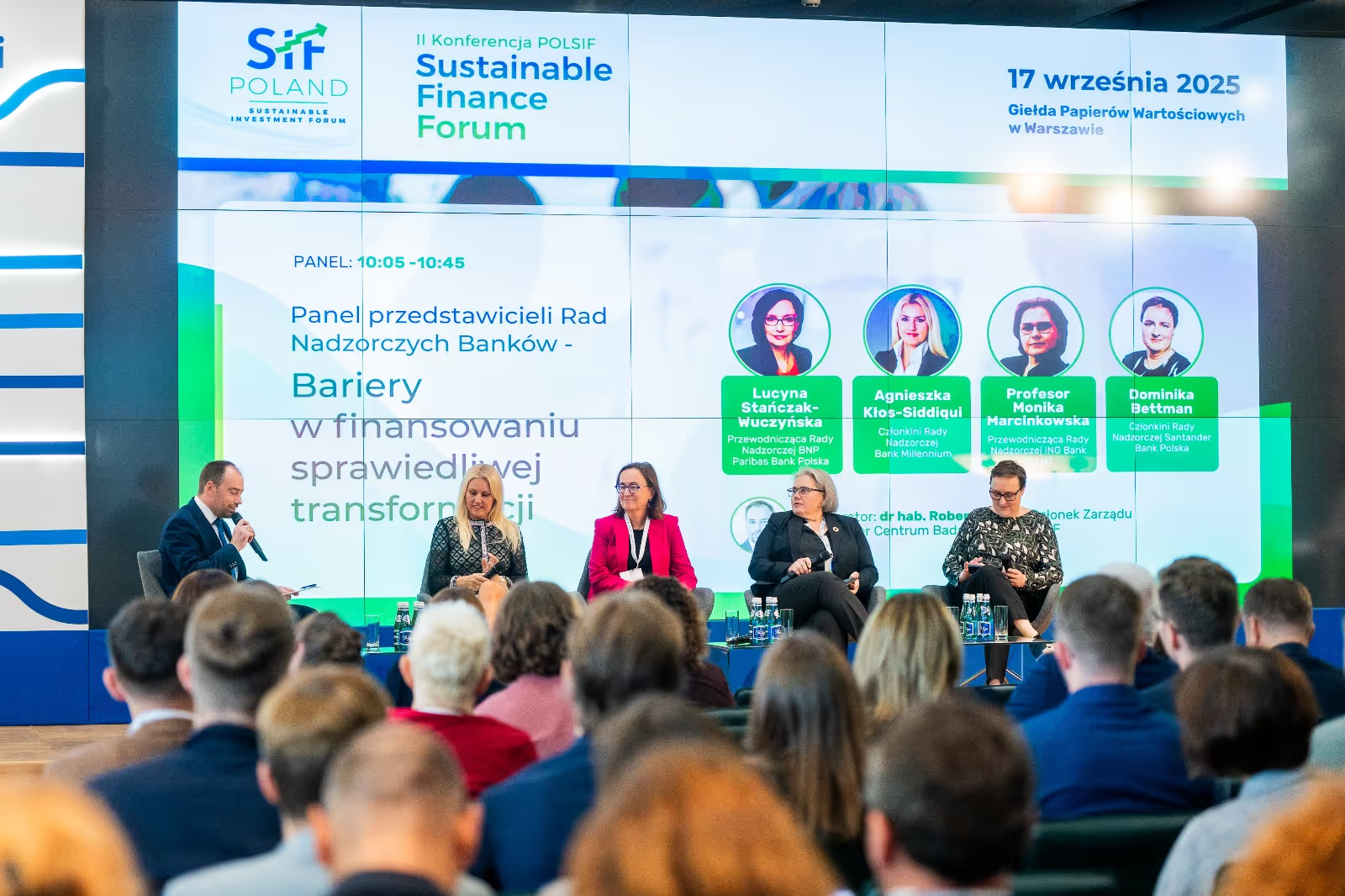
During the POSIF Sustainable Finance Forum 2025 conference, we talked with members of the Supervisory Boards of banks about financing a just transition of the economy. In particular, on the importance and influence of Supervisory Board members, the role of banks, main activities and challenges.
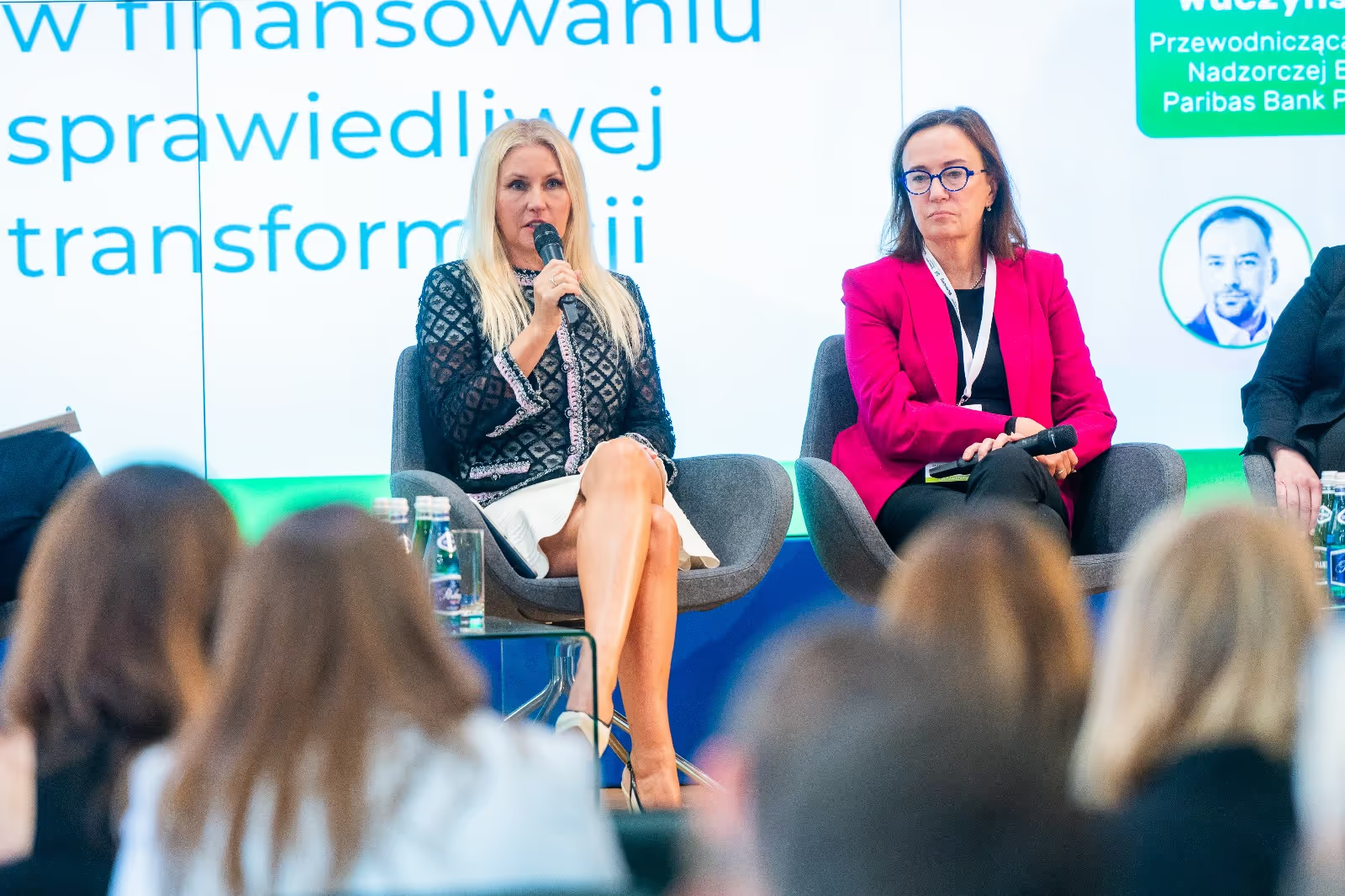
Below we present the conversation of Robert Sroka, Member of the Management Board of POLSIF with Agnieszka Kłos-Siddiqui, member of the Supervisory Board of Bank Millennium.
How do you see the role of Supervisory Boards in the context of changes related to sustainable development in companies?
The EU CSRD Directive, which extends and unifies the obligations of companies regarding the reporting of non-financial information, has also clarified the responsibilities of members of Supervisory Boards. The new regulations require us not only to oversee ESG reporting, but also to demonstrate that we have the appropriate competence and expertise in this area.
In addition, ESG reports must include detailed information on the environmental, social and corporate impact of the business, as well as be independently certified by statutory auditors. The Supervisory Board will be responsible for overseeing this entire process, from the moment the auditors are selected to receive the result of the attestation, which requires us to be more involved and cooperate with the management and audit committees.
ESG is an integral part of Bank Millennium's strategy, which undoubtedly also affects the approach to issues related to this area?
Of course, this opens up the possibility of more effective action. From the perspective of my role — Chairman of the Audit Committee of the Supervisory Board, I am aware of the obligations imposed by CSRD also on the Audit Committee of the Supervisory Board, such as monitoring the process of sustainable development reporting, including the selection of relevant topics covered in this reporting (double importance study), or monitoring the effectiveness of internal control systems and risk management systems and audit internal ESG reporting. In addition, there are obligations related to the process of selecting an audit firm to which the sustainability reporting attestation service is commissioned. This shows how important our role in this process has become.
How do you see the role of banks in financing the transformation of the economy?
The transformation of the economy towards sustainable development is one of the most important challenges facing the financial sector today. Banks, as institutions of public trust, have a key role to play — not only as a source of capital, but also as a strategic partner supporting clients in this change.
And how is Bank Millennium located here?
Financing the transformation is an important part of our action strategy “Strategy 2028 — Value and Growth”, which we announced last October. It involves, among other things, the granting of PLN 5 billion of financing for projects related to sustainable development in the years 2025-2028 (this objective includes loans to enterprises and retailers).
How will this sum translate into specifics, for example, regarding the products and solutions offered to customers?
In terms of product offering, the bank is actively developing solutions supporting green transformation. An example is the ECO mortgage introduced this year — a product aimed at people buying energy-efficient properties, which offers preferential financing conditions. This is a real support for clients who need financing for properties that meet energy efficiency standards. Nor is it an individual action. The Bank has implemented a responsible financing policy that takes into account environmental and social risks in lending and investment processes. This means that financial decisions are made taking into account the impact on climate, local communities and long-term value for stakeholders. It is also worth mentioning the first issue of green bonds, which we carried out a year ago.
Bank Millennium not only finances the transformation, but co-creates it. In 2023, we reduced our own emissions (ranges 1 and 2) by 70% compared to the base year 2020 and we are consistently working towards further reductions, aiming at full neutrality as a result.
What are the key barriers to offering transformational finance?
From the perspective of the banking sector, it would be necessary to identify several key challenges that we are facing. First, all the time, many companies do not have sufficient awareness of ESG, and therefore do not know what opportunities investments in sustainable projects offer. At the same time, they do not understand that the delay in implementing sustainable development activities can lead to a decrease in competitiveness.
Secondly, there is still a lack of simple, transparent and, above all, achievable standards to define what can really be considered sustainable financing.
Third, regulatory uncertainty is given to the signs. Dynamically changing regulations — both national and EU — mean that financial institutions have to constantly adapt their strategies, processes and reporting systems. This generates costs and requires a lot of operational flexibility.
Fourthly, there is a lack of sufficient ESG data and difficulties in verifying it. Finally, fifthly, the sector is counting on the further development of systemic incentives for companies. Such support in the form of grants or public guarantees or tax breaks gives clients a huge incentive to use sustainable loans on a larger scale.
The goal of POLSIF is to increase the value and quality of sustainable financing. Do you see solutions that would unlock the potential of sustainable finance in banks? To facilitate the answer, let's narrow the discussion area only to the area of credit.
Banks could benefit, for example, from a reduction in capital requirements for sustainable assets. This would be an additional stimulus for the development of sustainable finance and potentially provide the opportunity for cheaper financing through lower capital burdens. Secondly, let's not forget the need for education and awareness building. At Bank Millennium, we have implemented, for example, a digitized customer communication process that includes a digital ESG survey, which helps us assess and help clients understand their sustainability profile and maturity in this regard. Finally, banks should have access to better ESG data. The lack of specific, measurable ESG data on Polish companies and financed activities makes it difficult to classify loans as “green”. Shared data platforms, accessible public data registers and standardised reporting could support banks in providing sustainable financing.

LEGAL CENTER
SUSTAINABLE
INVESTMENT AND FINANCE

STANDARDS CENTER
SUSTAINABLE
INVESTMENT AND FINANCE

Research Center
SUSTAINABLE
INVESTMENT AND FINANCE

EDUCATIONAL CENTER
SUSTAINABLE
INVESTMENT AND FINANCE