How to assess whether solar PV and wind investments are aligned with the EU Taxonomy? A practical guide by POLSIF
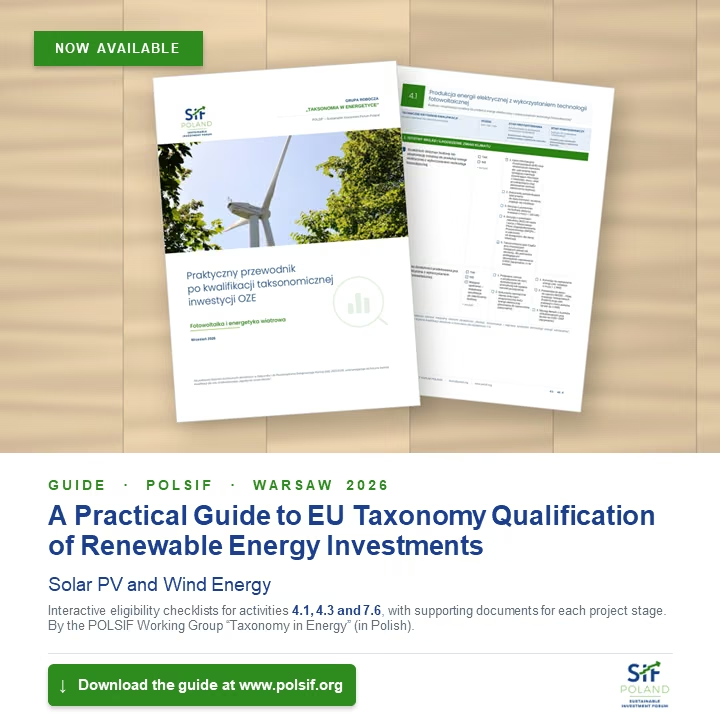
What documents can confirm that a solar PV or wind farm investment meets the EU Taxonomy technical screening criteria? At what stage of the project should they be available? The POLSIF “Taxonomy in Energy” Working Group has prepared a practical guide with interactive eligibility checklists for renewable energy investments.
The guide responds to questions that increasingly arise in the assessment and financing of renewable energy investments: how to demonstrate compliance with the taxonomy criteria, which documents can serve as evidence that they are met, and how to approach the assessment of environmental requirements. The publication is based on Annex I to Commission Delegated Regulation (EU) 2021/2139 and focuses on the environmental objective of “climate change mitigation”.
The guide includes eligibility checklists for three types of activities:
- 4.1 Electricity generation using solar photovoltaic technology
- 4.3 Electricity generation from wind power – with additional criteria for offshore wind farms
- 7.6 Installation, maintenance and repair of renewable energy technologies – covering PV installations and small wind turbines as technical building systems.
Each checklist guides the user through the substantial contribution criteria and the activity-specific “do no significant harm” (DNSH) criteria. For each criterion, the guide indicates example documents that can be used to demonstrate compliance, distinguishing between the investment preparation stage and the stage after commissioning. The guide also includes examples of climate change adaptation measures and good practices for protecting biodiversity in renewable energy projects.
The checklists are provided as interactive PDF files that can be completed and saved directly in the document.
The documents listed in the guide are examples only. Equivalent documents may be used, and the absence of a single document listed in the checklist does not automatically mean that the criterion is not met, unless that document is required directly by applicable law.
The guide is a practical tool supporting investment assessment. It does not constitute an interpretation of the law, nor does it replace the individual project assessment carried out by the investor, financing institution or advisor.
The publication does not cover the assessment of compliance with the minimum safeguards set out in Article 18 of Regulation (EU) 2020/852, which are one of the conditions for an activity to qualify as environmentally sustainable under the EU Taxonomy.
The work of the Working Group was coordinated by Joanna Sobótka-Klimczak (Member of the POLSIF Management Board, ING Bank Śląski). The Group brought together 30 experts from: Alior Bank, Bank Gospodarstwa Krajowego, Bank Millennium, Bank Ochrony Środowiska, Bank Pekao, Citi Handlowy, CVI Dom Maklerski, Erste Bank Polska, ING Bank Śląski, mBank, Pekao Investment Banking, PKO Bank Polski and Polenergia.
Members of the Working Group (30 people, in alphabetical order):
- Magdalena Andrejczuk – mBank
- Mariusz Bartosewicz – Bank Pekao
- Przemysław Bartoszewicz – Erste Bank Polska
- Aleksandra Bobrowska-Chwat – Bank Ochrony Środowiska
- Magdalena Dąbrowska – Erste Bank Polska
- Robert Dąbrowski – ING Bank Śląski
- Anna Frankowska – Pekao Investment Banking
- Anna Iwanek – Alior Bank
- Katarzyna Jędrzejczak – mBank
- Agnieszka Kacprowicz – PKO Bank Polski
- Michał Kołek – ING Bank Śląski
- Maciej Konieczny – ING Bank Śląski
- Piotr Kowalik – Bank Gospodarstwa Krajowego
- Łukasz Kozioł – Alior Bank
- Agnieszka Łukasiak – Polenergia
- Magdalena Mazek – Bank Pekao
- Barbara Miałkowska – Bank Pekao
- Agnieszka Muszyńska-Szymczak – mBank
- Daniel Owczarczyk – Bank Millennium
- Marta Porzuczek – Polenergia
- Michalina Romanowska – Erste Bank Polska
- Marta Rozwadowska – Bank Ochrony Środowiska
- Joanna Sobótka-Klimczak – ING Bank Śląski
- Kamila Szarejko – ING Bank Śląski
- Magdalena Światowska – Citi Handlowy
- Jolanta Turek – CVI Dom Maklerski
- Kamil Tylutki – PKO Bank Polski
- Maciej Więckowski – PKO Bank Polski
- Sylwia Wochal – ING Bank Śląski
- Katarzyna Wójcik – Bank Millennium
We would like to thank everyone for their commitment.
Questions and comments on the material: biuro@polsif.org

LEGAL CENTER
SUSTAINABLE
INVESTMENT AND FINANCE

STANDARDS CENTER
SUSTAINABLE
INVESTMENT AND FINANCE

Research Center
SUSTAINABLE
INVESTMENT AND FINANCE