National Transition Finance Framework - draft for consultation
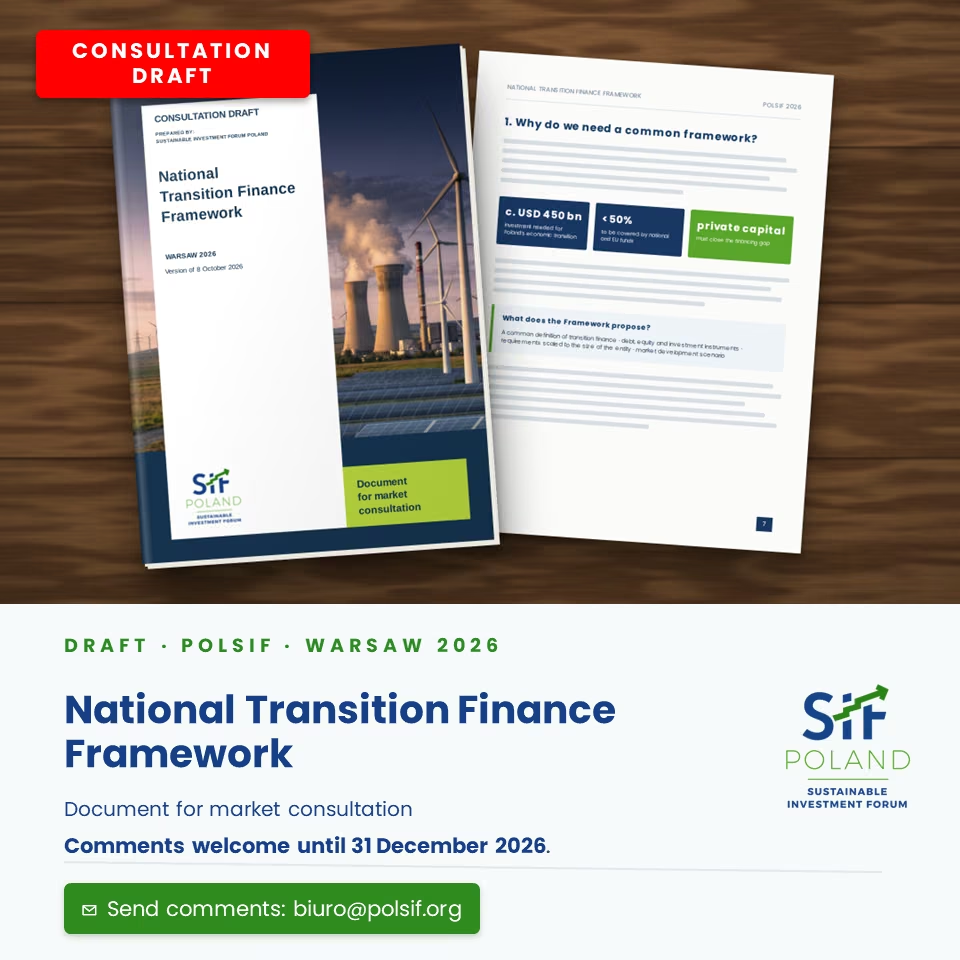
POLSIF presents the draft National Transition Finance Framework (KRFT), a document that sets out what transition finance is and what conditions it should meet to be credible. The draft is now open for market consultation, which will run until the end of 2026.
Why we need the Framework
According to World Bank estimates, the transition of the Polish economy towards climate neutrality by 2050 requires investment of around USD 450 billion. Less than half of this amount can be covered by national and EU funds - the rest must come from private capital.
Today, this capital flows mainly to projects that are already “green”. The hardest to finance are interim activities: reducing the negative impact of companies in sectors facing the greatest challenge of changing their business model, such as conventional power generation, steelmaking, chemicals and cement.
The market has responded with a new category of instruments - transition instruments. However, existing standards focus on decarbonisation and leave out the other environmental objectives. They do not take into account local challenges, the specific situation of SMEs and public issuers, or the assumptions of the SFDR 2.0 proposal. There are also no standards for transition equity instruments.
What the National Transition Finance Framework is
The Framework is intended to be the foundation for a system of financing the transition of the Polish economy and a starting point for a discussion between the public sector, the financial sector and businesses. It does not replace the ICMA, CBI or LMA standards, but complements them with the Polish context.
The document proposes a common definition. Transition finance is financing which - although it does not make a substantial contribution to the climate or environmental objectives of the EU Taxonomy - reduces the negative impact of an entity or activities on those objectives, as supported by scientific evidence. The definition covers all six Taxonomy objectives, not only decarbonisation.
The Framework distinguishes two categories. In line with market standards, the term “transition instruments” is reserved for instruments financing decarbonisation aligned with the Paris Agreement. The broader category is instruments financing the transition: financial instruments that mobilise and direct private capital towards activities and investments supporting the transition, including with regard to the other environmental objectives.
The Framework includes:
- a catalogue of sectors and entities that particularly need transition finance, including local government units (JST), municipal companies and State Treasury companies;
- a description of the types of instruments financing the transition: debt instruments (loans and bonds), equity instruments (shares and stakes) and investment instruments (funds, including those with an SFDR 2.0 transition label);
- requirements proportionate to the size of the entity: a transition plan for large entities, transition indicators for medium-sized entities and an independent assessment for small entities, local government units and municipal companies;
- requirements for transition projects, including the “do no significant harm” (DNSH) principle;
- a market development scenario and a map of interim steps that should precede the creation of the system.
How the document was developed
We began work in spring 2026 as a project for a National Transition Bond Standard (KSOT). We invited advocate Roksana Kałużna-Bałazy of kaluzna legal, who has advised on issuances of sustainable financial instruments on the Polish market, to contribute her expertise.
Our starting point was recognised international standards: the ICMA Climate Transition Finance Handbook, the Climate Bonds Initiative transition criteria and the LMA principles. We also took into account the EU Taxonomy, the proposed changes to the SFDR (SFDR 2.0) and experience from transactions carried out to date on the Polish and European markets.
As the work progressed, the scope of the document broadened: from bonds to debt (loans and bonds), equity and investment instruments, and from decarbonisation to all climate and environmental objectives of the EU Taxonomy.
During consultations with the banking sector, it was pointed out that in market standards the name “transition instruments” is reserved for decarbonisation instruments. We therefore introduced a second, broader category - instruments financing the transition. This was also the reason for renaming the document the National Transition Finance Framework (KRFT).
The current version of the draft is dated 9 October 2026.
Next steps: consultations until the end of 2026
The Framework is not a closed document. It is a framework that we want to fill with content together with the market. The first step is to present the draft to the CEOs of investment fund management companies (TFIs) and to hold a meeting to discuss it with investors.
By the end of the year, we will hold four rounds of consultations:
- with issuers and borrowers from hard-to-abate sectors - on their needs, barriers and expectations;
- with local government units and municipal companies - on the specific nature of public entities and their projects;
- with the financial sector, in particular public development banks - on the feasibility of the solutions and support mechanisms;
- with the Ministry of Finance and the Polish Sustainable Finance Platform - on the possibility of obtaining public funds for support mechanisms.
During the consultations, we will also examine which incentives could kick-start the market: guarantees, first-loss tranches, capital preferences for banks or tax relief.
The next steps on the roadmap - a list of sectors, national transition pathways, a list of transition activities, detailed criteria for entities and projects, and a methodology for assessing credibility - require further expert work. We want to carry them out in the next stage, together with our partners.
We invite your comments
We encourage all market participants - issuers, banks, investors, local governments and experts - to read the draft and send their comments, together with proposed solutions, to biuro@polsif.org.
Project contact: Ewa Noji, Project Coordinator, e.noji@polsif.org

LEGAL CENTER
SUSTAINABLE
INVESTMENT AND FINANCE

STANDARDS CENTER
SUSTAINABLE
INVESTMENT AND FINANCE

Research Center
SUSTAINABLE
INVESTMENT AND FINANCE